By: Ida V. Eskamani, Senior Director of Legislative Affairs at State Innovation Exchange
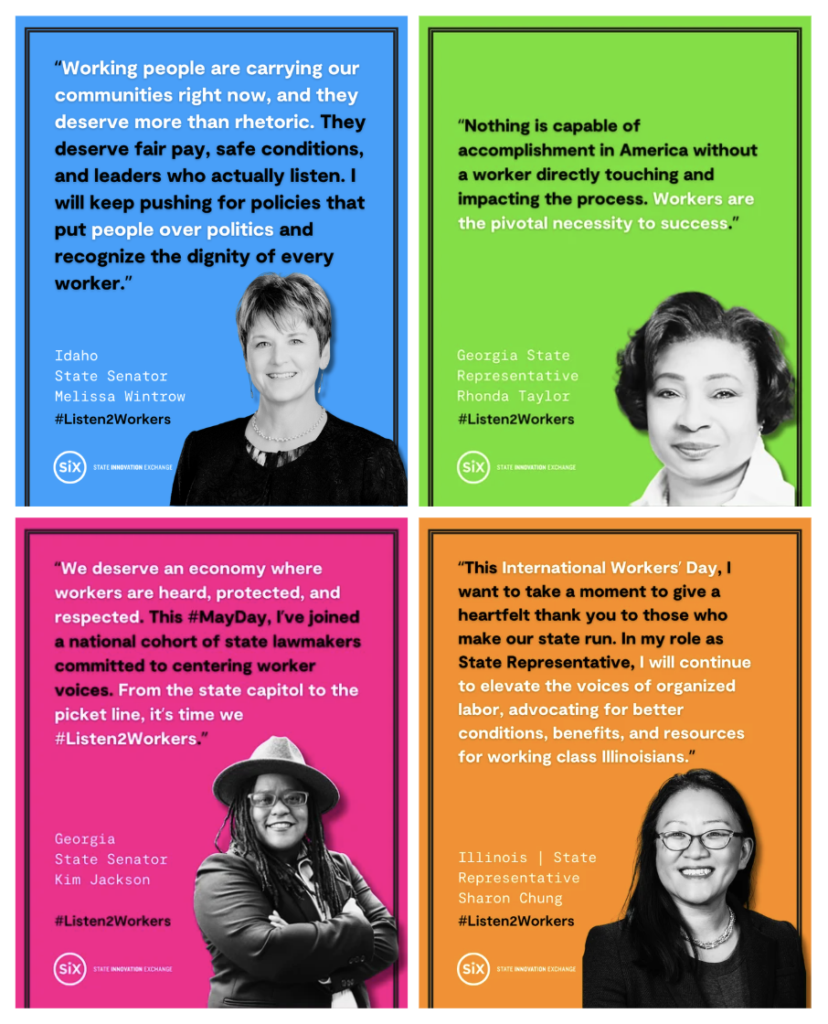
This May Day, or International Workers Day, SiX's Economic Justice Initiative proudly recognized the nearly 100 state legislators across the country who signed the #Listen2Workers pledge, a public commitment to elevate the voices and policy agenda of workers in their districts.
The #Listen2Workers campaign is a collaborative initiative led by End Poverty in California (EPIC) and the State Innovation Exchange (SiX), alongside partners like SEIU California, Southern Economic Advancement Project and Caring Across Generations, to amplify the stories of workers, highlight state legislators who elevate workers in policymaking, and demonstrate what’s possible when workers and state legislators work in collaboration towards brighter futures. To participate, legislators signed a formal pledge committing to listen to working communities, record interviews with workers in their districts, and introduce legislation that reflects the actual needs and struggles shared by those workers.
To learn more about how states are championing workers, join us for a briefing: State Strategies to Build Worker Power. The meeting will cover how every state can solve the affordability crisis by building a pro-worker economy, and share successful case studies across the country states can adapt, from resourcing worker centers, strengthening unions, and enabling worker ownership. This briefing is open to legislators and legislative staff.
Why State Leadership Matters More Than Ever in Public Health
Why State Leadership Matters More Than Ever in Public Health
By: Geran Tarr, Former Alaska State Representative, SiX consultant
In December 2024, a month after the presidential election and in conjunction with the SiX National Conference, SiX took 15 state legislators to visit the National Centers for Disease Control and Prevention (CDC) in Atlanta. Fifteen months of the second Trump Administration later and looking towards National Public Health Week April 6-10, it is hard to process how much has changed.
The nation’s public health infrastructure has been gutted, with disastrous effects that will take decades to fully understand. Staff have departed key health agencies, including the CDC and Department of Health and Human Services, over questionable public health decisions not grounded in scientific evidence, and the public is now left wondering what and who to believe.
During our 2024 visit, we learned from public health experts about the critical role the CDC plays in protecting public health, from securing talented advisors to establish evidence-based vaccine policy (all of whom have now been dismissed and replaced) to preventing mass outbreaks of illness through intricate surveillance programs and so much more. We learned that 90% of CDC funds are returned to states for public health needs. The CDC is just one federal public health agency under attack from the current administration. Given all of this, state legislators' role in public health has shifted, giving them more responsibility in protecting their constituents.
Across the country, state legislators and the communities they represent are feeling the deep impacts of the federal budget cuts and dismantling of critical public health infrastructure, particularly in rural areas. For National Public Health Week, we’re highlighting some of the ways that legislators are organizing, strategizing and stepping up to protect public health through policy that brings together agriculture, food, rural, and health issues including on toxics and pesticides policy, food access policy, and infrastructure and rural health access policy.
Pesticides and Toxics
For three sessions running, Midwestern and Southern states have been battlegrounds for a controversial pesticide immunity bill. The so-called Bayer bill (also known as “Cancer-Gag” or “Failure to Warn”) would prevent farmers, workers, and families from taking legal action if they suspected an illness like cancer was the result of pesticide use.
Why are these deeply unpopular bills being pushed in states? In a David vs. Goliath scenario unfolding in courtrooms across the country, farmers and rural residents with cancer have been successfully suing chemical giants like Bayer and Syngenta for making them sick. A great deal of evidence points to links between Bayer’s Roundup herbicide (with the active ingredient glyphosate) and cancer and Syngenta’s paraquat and Parkinson’s disease. After paying millions of dollars in lawsuits, these companies have taken a different tack: passing state legislation to prohibit lawsuits. State legislators are stopping these bad corporate actors and holding them accountable for making farmers sick. In Iowa, for example, SiX's Cohort for Rural Opportunity and Prosperity (CROP) member State Representative Megan Srinivas, a physician, held cancer listening sessions to surface community health concerns from rural Iowans, including concerns about the Bayer bill. Other toxics and pesticides policy where state legislators are leading includes addressing PFAS contamination, removing toxic metals in baby foods, and bans on chemicals in foods, personal care products, and agriculture, including proposed bans on paraquat due to its links with Parkinson’s.
Hunger and Food Access
As the federal government took a hatchet to federal SNAP funding and food programming in 2025, state legislators across the country worked hard to fill the “SNAP gaps” created by federal actions, food price inflation, and program changes that will limit access, like instating a work requirement for SNAP benefits. Food is a basic need and without proper nutrition our communities suffer. State legislators recognize the critical importance of food access in building and maintaining health communities, which is why policymakers are creating new and innovative programs to fund free and reduced school lunch programs, expanding access to fresh, healthy foods, and partnering with farmers to expand their reach. These state-funded programs can operate independently of the federal government, securing food access for their neighbors. With recent estimates showing the cuts to SNAP could lead to 70,000 avoidable deaths and the current federal government showdown resulting in delays in receiving food benefits, these are just the most recent examples of how critical state actions are in protecting communities from the impacts of federal actions.
Systemic disinvestment in rural America has been happening over decades, aided by inadequate state and federal policy that leaves rural communities behind, and won't be fixed overnight. However, with state legislators leading the way and creating a proactive and positive vision for rural public health through co-governance based rural organizing, we know that positive change can be lasting.
The theme for this year’s National Public Health Week is Ready. Set. Action! and state legislators are showing they are ready to lead on public health and already are taking action. Let’s applaud and uplift the important public health work of our state legislators! Happy National Public Health Week 2026!
Building Rural Power: Midwest CROP Workshop Brings Legislators and Partners Together
Building Rural Power: Midwest CROP Workshop Brings Legislators and Partners Together
By Siena Chrisman
At the end of June, SiX hosted its first Midwest Movement-Building Convening and Farm Tour, in and around Omaha, Nebraska. Ten state legislators from six Midwestern and Plains states joined SiX staff, our partners at Nebraska Communities United, and other regional rural advocates for two days of tours, learning, and strategy sessions.
The event was part of SiX’s ongoing investment in progressive organizing across perceived urban/rural divides. While urban and rural communities are often painted as diametrically opposed, the reality is that Americans face common struggles and share common values no matter where they live. Bringing together urban and rural leaders to build relationships and learn about each others’ realities is a critical way to build progressive power for the future we want.
After setting the stage with a short Nebraska agriculture history, analysis of corporate power, and research on rural values, the group spent a day on the ground in rural Nebraska, seeing both some of the worst extractive industrial agriculture practices and inspiring, scalable regenerative farms.
Greg Lanc, a farmer and farm machinery mechanic, took the group on a tour of his rural neighborhood, which has been overrun by dozens of concentrated animal feeding operations (CAFOs): large-scale chicken barns, a cattle feedlot, an enormous calf-feeding operation, a mega dairy, and more. A CAFO of one kind or another is visible from nearly every intersection of the gravel roads in a several-mile radius of Lanc’s house.
The chicken houses, where millions of Costco’s $4.99 rotisserie chickens are raised, are the worst, spouting dust, bacteria, and an overpowering smell of ammonia into the surrounding air. Many days, Lanc cannot spend time outside on his property because the smell is so bad. Chicken and feed trucks kick up dust and wear down the gravel roads and Lanc has documented dead chickens left in open dumpsters just uphill from streams. Costco promised the barns and the nearby chicken processing plant would bring jobs and other economic benefits to the community, but that has not been the case.
This kind of factory-style farming is often touted as an economic boon for rural communities, but research repeatedly proves what the neighbors know: industrial farms extract far more than they add. There are, however, numerous models of beneficial farm operations, including nearby in Nebraska.
Legislators and partners had lunch and a tour of Grain Place Foods, a regenerative farm and grain business. The farm has been certified organic in 1978 and its fields go through a nine-year rotation of grains and pasture for cattle, building healthy soil and a thriving ecosystem. The grains are processed at an on-site mill and sold in products locally, around the country and the world. Between the farm and the mill, Grain Place employs about two dozen workers, many of whom have worked there for decades, ensuring that the business not only invests in its natural resources, but in the economic health of its community.
Low clouds had threatened rain all day, but by the time the tour reached its last stop at Alex Daake’s farm, the sun was shining through. Daake has recently taken over part of his family’s land and is in the process of transitioning to a four-year rotation of corn, soybeans, small grain, and pasture. He grazes cattle on the pasture and sells them for beef. Between keeping a lookout for the newest calf born just that morning and admiring the many grasses, forbs, legumes, and flowers growing in the pasture, legislators discussed ways that state policy and other initiatives could support more diversified farm operations like this one.
On the final morning, back in Omaha and absorbing all they had experienced the day before, legislators heard about bridge-building organizing in Nebraska, Louisiana, Illinois, North Carolina, and elsewhere. They had stories of unexpected coalitions creating David-over-Goliath victories, like a mostly-red rural Oregon community partnering with progressive Portland legislators to pass rules to protect communities from new CAFOs; rural and urban Minnesota activists and legislators building long-term trust and determining priorities for a progressive policy agenda for the state, and much more.
Legislators and advocates left the convening excited to keep talking, to visit each other, and to dream across state lines. They went back to their districts with a greater sense of possibility for who their allies and partners might be – one urban legislator, considering previous stereotypes and all the people he had met over the two days, said, “I learned that I’m not as alone as I thought I was.”
Legislators, Indigenous Leaders, and Advocates Gather for First Ever Coastal Convening on Sustainable Aquaculture
Legislators, Indigenous Leaders, and Advocates Gather for First Ever Coastal Convening on Sustainable Aquaculture
By: Emma Newton
In July, legislators from across the country traveled to Seattle for a special three-day convening on sustainable aquaculture, working waterfronts, and tribal food sovereignty. Twenty-two state legislators from coastal states gathered with international advocates, experts, and Tribal Leaders for the first of its kind gathering hosted by the SiX’s Agriculture and Food Systems Program in partnership with Don’t Cage Our Oceans (DCO2). The event aimed to spark dynamic conversations, foster collaboration, and champion the protection of ocean economies and natural resources.
A Grand Opening: Culture, Community, and Celebration
The convening kicked off on Friday evening with an opening dinner. Attendees were warmly welcomed by Chairwoman Cecile Hansen of the Duwamish Tribe and SiX Co-Executive Director Neha Patel, who set the tone for the event by emphasizing movement building, collaborative governance and joy.
Yakima Tribal member Christina White of Native Candies, who’s husband personally fished for the salmon on the Klickitat River that was served at dinner, shared the meaningful story behind the meal. The evening was made even more special with a traditional song from a Yakima Elder, creating a sense of unity and gratitude among attendees.
Diving Deep: Discussions at the Duwamish Longhouse
Throughout the weekend, the Duwamish Longhouse and Cultural Center in West Seattle served as the meeting space where attendees engaged in thought-provoking presentations and discussions. Topics ranged from the threats posed by industrial finfish farming to ocean economies and resources, to the power and influence of corporate entities. Catalina Cendoya of the Global Salmon Farming Resistance shared insights on successful community organizing efforts against corporate fish farms in Latin America, where she stressed the strategic partnership between community leaders, chefs and policymakers.
A Journey to the Suquamish Nation
A highlight of the convening was a visit to the Suquamish Nation, where Tribal scientists and leaders showcased their innovative work in protecting the geoduck and developing a sustainable tribal-led seafood economy. Attendees visited the tribe’s oyster beds and salmon hatchery, and savored a delicious geoduck ceviche snack prepared by Tribal Council Member and fisherman Jay Mills.
Stories from the Waterfront
The final day of the convening was marked by an enlightening visit to Seattle’s bustling working waterfront. Policymakers and advocates heard firsthand accounts from independent fishermen at the Fisherman’s Terminal. The spectacle of “flying fish” as the St. Jude, an independent fishing vessel, docked to sell freshly caught tuna, gave attendees a real-world glimpse into life on a fishing boat.
The convening wrapped up with a compelling presentation from Gideon Mordecai, a fisheries scientist from British Columbia, who shared the science behind the impacts of industrial aquaculture. The event concluded with a picturesque lunch on the shore of the sound, leaving attendees inspired to return home and engage with their communities on these issues.
Building Bridges for a Shared Vision
Throughout the weekend, state policymakers forged meaningful connections and began exploring innovative ways to collaborate with local and international advocates and Indigenous communities. Together, they envisioned a future where ocean economies and natural resources are protected and celebrated.
A participant and Hawai’i state legislator reflected on the experience: “I am used to union organizing, where we are very explicit about expectations around connecting and growing power, collecting ‘data’ and evidence on our effectiveness in that regard. Now, I am thinking about how this translates into change-making in my own context. For policymakers to truly experience that additional level of connectedness, we need opportunities to act in support of each other and a shared vision.”
The Coastal Convening on Sustainable Aquaculture marked the beginning of a powerful movement towards a more sustainable and equitable future for our oceans and the communities that depend on them.