NEW SiX CASE STUDY: How Rural Iowa Beat the Pesticide Industry's Immunity Push
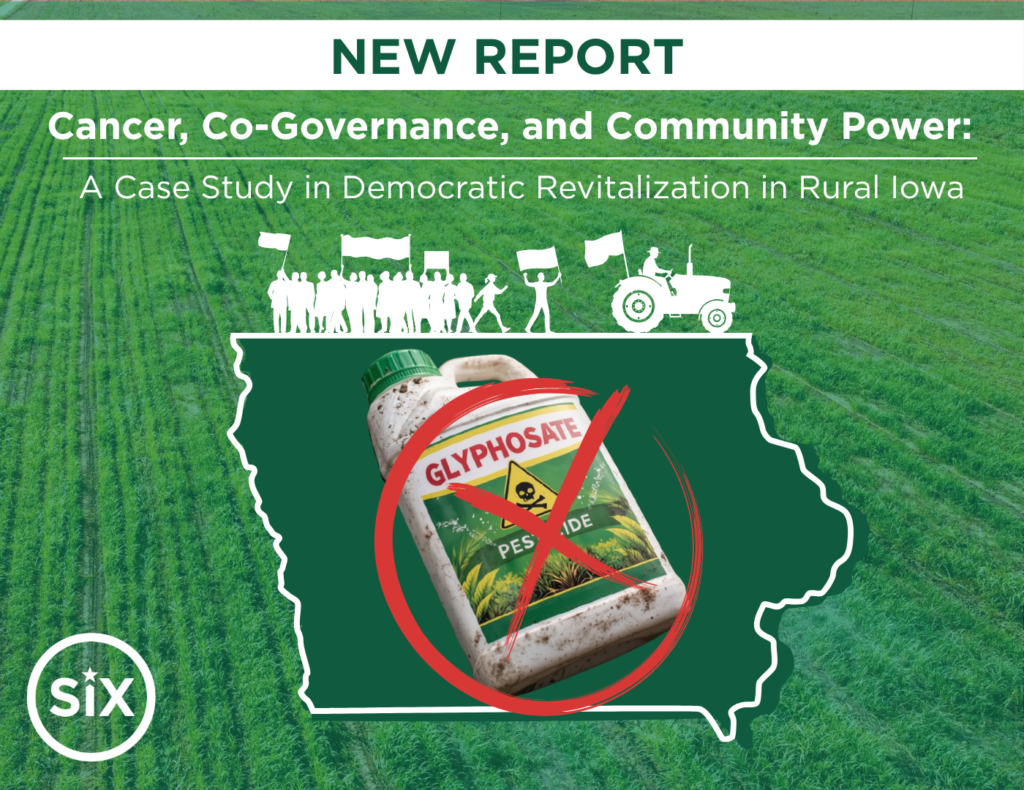
SiX's Food, Agriculture, and Rural Economies program has published a new case study, “Cancer, Co-Governance, and Community Power: A Case Study in Democratic Revitalization in Rural Iowa,” in the Community Organizing Journal. It examines how rural co-governance organizing can push back against the growing influence of corporate power in state legislatures.
The article, co-authored by Iowa State Representative Megan Srinivas, chronicles a three-year fight to stop a pesticide immunity bill in Iowa, an effort by the agrochemical giant Bayer to avoid accountability for the health harms caused by its products. It details the key players, the public health science, and the agricultural history underpinning Iowa’s current cancer crisis. The paper offers a detailed look at a trend relevant across geographies, issues, and the urban-rural divide: resource extraction and disregard for life in the interest of profit, power, and infinite growth.
We recommend you read it in full, and we have created a 5-Minute Guide to the case study highlighting some of the main points. Those points include:
- Iowa has the second-highest rate of cancer and the fastest growing rate of cancer in the United States, likely attributable to exposure to agricultural chemicals and waste. (Harkin Institute, Gerken et al, Myers et al)
- Elected officials in the minority can still win against entrenched corporate control by using rural organizing strategies to build bridges.
- Community-led rural listening sessions are a powerful co-governance tool. When legislators listen deeply to those with lived experience, they open the door to collaborative decision-making and a stronger democracy.
- Co-governance interrupts the vicious cycle of distrust, division, and disinformation, connecting policymakers directly to the public and strengthening democracy in the process.
Pesticide Immunity Bills Sweep the States; Communities Fight Back
Alternately known as the “Bayer bill,” “failure to warn,” or “cancer gag act,” the Iowa bill was part of a multi-state campaign backed by Bayer (which bought Monsanto in 2018) and the pesticide industry to pass state-level bills giving immunity to chemical companies for the harms caused by their products, including cancer.
From 2024 to 2026, over three legislative sessions, state legislators from Iowa to Florida successfully fought off these bills using unique organizing strategies and protecting the rights of their constituents to pursue legal remedies in the process. This strategy was so successful in preventing corporate immunity, however, that in June 2026, the Supreme Court intervened on behalf of the pesticide industry, siding with Monsanto in Monsanto v. Durnell and granting immunity to pesticide manufacturers in all fifty states.
Building Common Ground Through Co-Governance: Lessons From the Research
Drawing on interviews with rural advocates including Iowa Farmers Union, state policymakers on both sides of the aisle, and rural community members, SiX’s Food, Agriculture, and Rural Economies team shows how policymakers in the minority can still win against entrenched corporate control. Progressive state legislators can find common ground with rural communities and their conservative colleagues through shared values. This result is a bipartisan coalition capable of successfully defeating corporate power grabs.
The paper examines the co-governance process behind community-led rural listening sessions. In partnership with Iowa Farmers Union, Co-author Rep. Megan Srinivas co-hosted multiple listening sessions across rural Iowa during the 2025 session to hear from communities, farmers, and family members impacted by cancer. The listening sessions provided an outlet for rural community members impacted by these devastating illnesses to share their stories with those in power. By focusing the sessions on the real human impacts of the cancer crisis instead of the Bayer bill, Rep. Srinivas was able to build bridges with conservative Iowans, ensuring they felt that they had a voice in the democratic process.
A Model Worth Replicating: Rural Organizing to Build Power
“The story of defeating the Bayer Bill in Iowa is what happens when people in power choose to listen to the communities with lived experiences, said EJ Juárez, Executive Director of State Innovation Exchange. When legislators sit down and truly listen to the farmers and neighbors living with the consequences of our policies made in far away capitols, they become partners. That’s the heart of co-governance: policy that actually reflects our communities, rural places, and farmers. Co-governance isn’t just a theory for us. This case study shows it’s a practical way to rebuild trust, protect people’s rights, hold corporations accountable and strengthen democracy”
Since 2025, SiX, in partnership with Rep. Srinivas, has promoted the organizing strategy of listening sessions to build strong coalitions, fight corporate power, and revitalize civic participation in rural communities. The case study presented in Cancer, Co-Governance, and Community Power: A Case Study in Democratic Revitalization in Rural Iowa examines co-governance theory and the power of legislator-community partnerships to safeguard democracy and hold corporations accountable in state policy.